I’m now a few months into some new hobbies, and I reckon it’s about time to check in with myself. I’ve learned quite a bit since December/January (I think?) in a few various different areas.
I’ve taken a keen interest in fungi and edible mushrooms in particular, as well as foraging in general, and through that I have taken to looking into the world of fermentation. My diet has been progressively changing over the last couple of years in part due to my partner’s interests, and in part from the post-pandemic recognition that my diet really needed to improve. Even in the before times (as I call them), my diet although not abysmal had plenty room for improvement: I pretty much ate significant quantities of meat at every meal, and vegetables were mostly a bland garnish and afterthought. Nowadays meat is more sparse (although admittedly still very present – just in smaller amounts), I am trying to rekindle my use of spices and herbs properly, and discovering new food types altogether… and getting out more. It’s not diet, but it’s still health.
Fungi
As far as the hobbies go, the initial impetus was found after watching Fantastic Fungi, a Netflix-released documentary covering a wide set of aspects, from the role of fungi in mycorrhizal networks, and Paul Stammets’s adventures with psilocybin and mycoremediation, among many topics. The very idea of a “wood wide web” was astounding to us. The expression I believe to be in a bit of contention as it carries its own baggage as a metaphor, but it really does set the imagination and awareness up for curiosity.
In my previous post, I noted I had a dislike for “mushrooms” until very recently; but discovering that I could explore them more than just the boring (and to me, unappealing) A. bisporus of the supermarket shelf staple, I decided it was time to properly venture forth.
I had eaten enokitake in Japan and this certainly unblocked me mentally, but I had not yet gone out to seek any. It was only when I was in an Asian grocery store that I saw some mushrooms that I recognised from a long-time favorite anime, Shokugeki no Sōma (known in English as Food Wars), and decided I had to buy some.
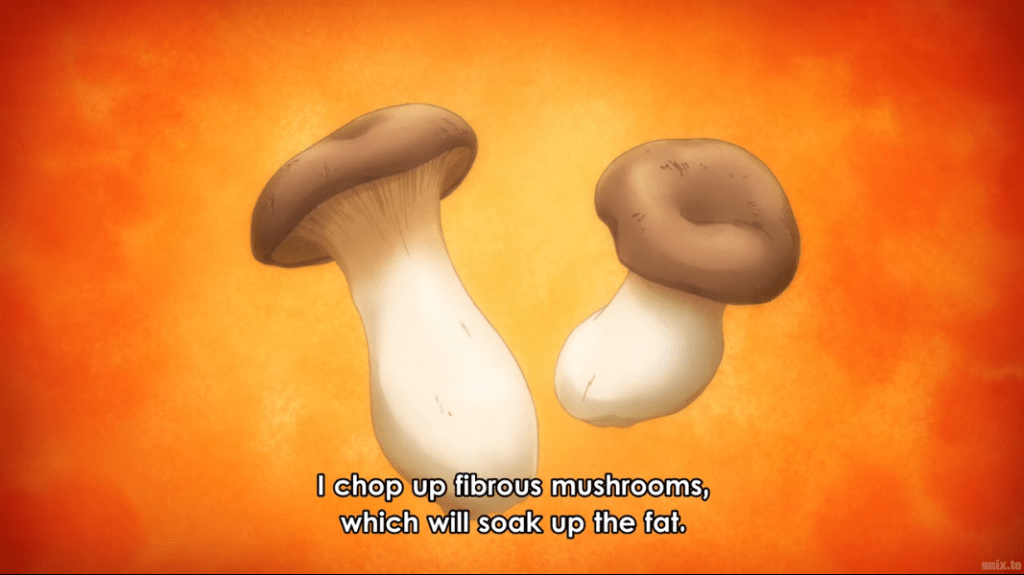
They were labelled “chicken leg mushroom” and after trying and failing to find them under that name, eventually found their better-known moniker: king oyster mushroom, or Pleurotus eryngii for their scientific designation.
It was nothing short of a revelation to me. They cook meaty, not mushy. Their flavour is properly umami, not murky (still cursing at you, A. bisporus). Their texture is firm, not floppy. An all-round winner. Out of all mushrooms to cook with, these are my favorite. They are best pan-fried in a bit of oil, and take well to seasoning – salt and pepper of course, but herbs and butter too.
I have since found that most Asian stores stocking fresh produce will have a bunch of these in vacuum pack, and my local independent grocers also stock them loose and sold by weight. Still, the regular supermarkets are missing a trick with these by not stocking any. More fool them.
Other mushrooms I can readily get at the Asian store are enoki (the long stringy ones) and shimeji (brown-cap and white-cap, sometimes known as “beech mushrooms” but other mushrooms are known in association with beech so I avoid that name for clarity’s sake), both of which do very well in soup, and can be tossed in for under 5min to good effect. They don’t pan-fry all that well, though I have seen recipes for enoki that bread- and deep-fry them.
Also, regular oyster mushrooms, which similarly hold well to pan frying. They can be pulled apart by hand lengthwise, then simply seasoned and fried in a light amount of oil, to … easily give the meat a rest (I can easily rant about not calling these meat substitutes, but I’ll leave that for another post).
Oyster mushrooms are my second favorite to work with and eat. So much so that we embarked on a workshop to learn to grow them at home (see my prior post on this blog). It’s work, and if where I lived it were difficult to come by any I would certainly engage in it, but it turns out our local grocer also sells them by weight, so after a mildly successful growth attempt, the activity was shelved and we buy them. This nearly did become an earnest hobby, but to me is too prone to being forgotten, owing to needing regular care and also needing to be hidden away from sight. I just can’t.
Forage
As I continued to look into mushrooms, it became apparent that there was a whole world out there of edible wild mushrooms just waiting to be explored. Gata tells me that Polish people make a national hobby of collecting mushrooms in high season – even city folk. Being of the generic British upbringing, I was no more knowledgeable than the rest: the one key identifier we know for mushrooms is that it’s edible when it comes from the supermarket. In the wild ? Don’t touch ! Might be dangerous !
Nevertheless, I embarked on a journey of reading everything I could about the topic – at least, that’s readily available on the Internet for the neophyte.
One site that kept coming up in results was Wild Food UK‘s mushroom guide . I was able to learn from their videos the importance of locality when learning to identify mushrooms. The first mushroom I learned to forage was the jelly ear, Auricularia auricula-judae. I learned quickly that it is in principle the same species as what is sold in the Asian stores and in hotpot joints as “edible black fungus.” For safety, it should only be picked from elder tree, as there it is unmistakable and the host wood itself is guaranteed safe.
Cooked-through (simmered 15min), the jelly ear makes for a very good mushroom to add to soups for texture. These in particular have an extremely high water content so they don’t fry well – or rather, they are at risk of exploding if fried with any amount of oil…! But diced and boiled, they provide excellent bite and texture in a Asian-style thin soup/broth.
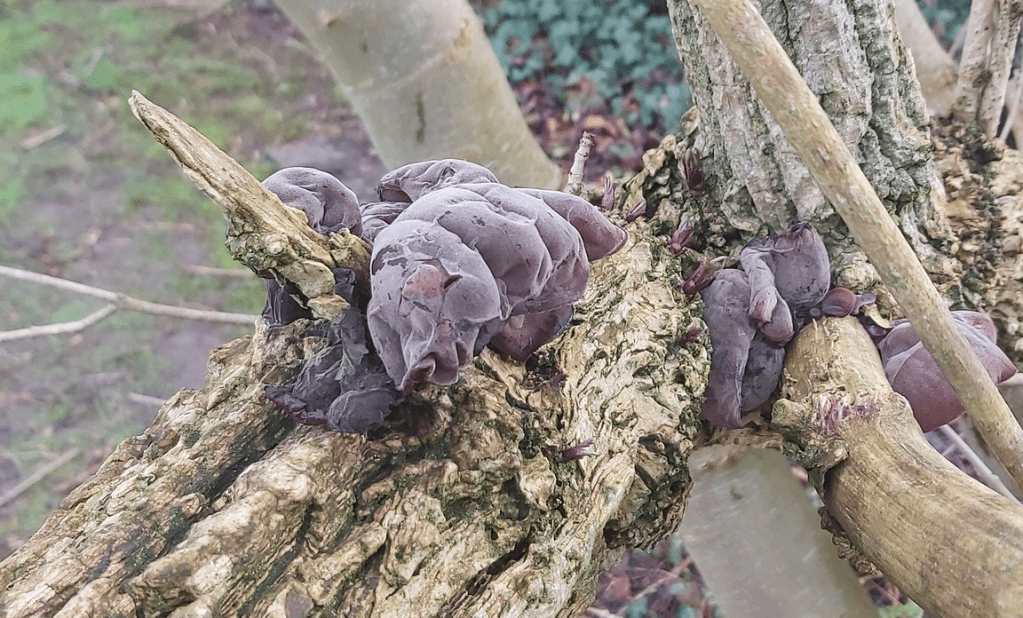
We picked a good few on our first every self-taught forage, and I set about cleaning them and pre-boiling them (taking no chances !), then chopping them, and finally adding them to a quick soup made with stock cube, soy, five-spice and spring onions and coriander. It wasn’t high gastronomy by any measure, but it was thrilling. My first ever foraged food, and for both of us, our first ever self-taught foraged food. Exhilarating!
I further went on to look for good field guides and bought initially three books – Roger Phillips’s book, as well as the Collins Gem and another Collin’s (I think I mentioned them last time). The third one I have given away as I felt it was not really good – neither well-summaried, not as comprehensive as Phillips’s tome. I have since acquired Wild Food UK’s own field guide, as well as Geoff Dan’s more generalist publication.
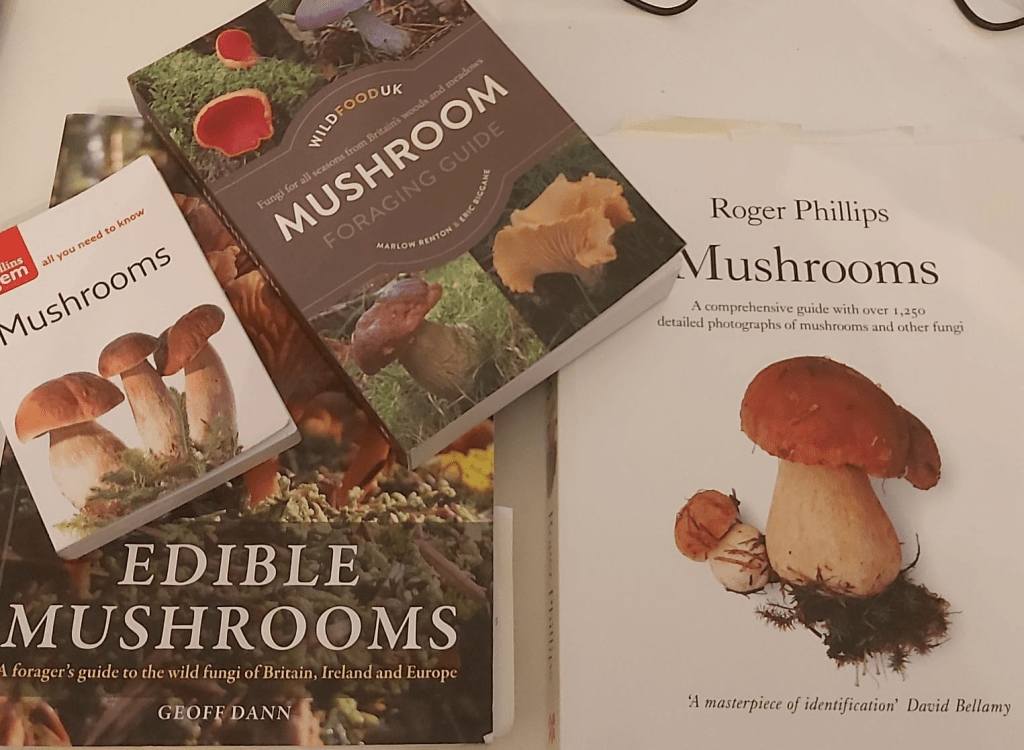
As we come out of winter here in the UK, I continue to consult all four on a regular basis as I continue to shore up my knowledge and awareness. I want to be ready to roll as much as possible when the real season begins ! As part of this, I have also been studying tree identification – a lot of mushrooms that are worth eating are associated with specific trees, and being able to spot or recognise promising locations will be a clear asset. It’s also mighty fun.
My Polish colleague Miko advised me once: “don’t bother looking for mushrooms anywhere you can get to by bus – the Polish people will already have taken them!” A Polish documentary on mushrooms further confirmed it. Well.
We went on a Wild Food UK outing in March to get our feet wet and be able to ask questions of a firmer expert, and I am going to another outing in May. In June I am looking to do the fungi identification course which is aimed at more intermediate foragers and forayers, and I intend to have a good amount of knowledge down pat. I have taken to walking with at least one if not two field guides on me at all times. On our social walks, I have been jokingly been identified now as The Library. Oh well !
The WFUK outing we did in March taught us about quite a few things – of which, don’t be an idiot, and don’t try to pick anything that looks remotely cousin to hemlock as a beginner – and as an intermediate, nothing looking passing like it either, even with diligence and care, it’s a roulette game to play. Just to hammer this one home, you can watch this short 30sec video.
On the brighter side, I learned about the Plantago genus, and how it can be used in the wild as a quick anti-inflammatory (have plenty on hand before going picking nettles I personally reckon), and potentially as a tea as an anithistamine. I have tried to look for the studies that are purported to uphold the traditional medecine aspect for this, and there seems to indeed be strong interest in the plant:
- https://www.ncbi.nlm.nih.gov/pmc/articles/PMC7142308/
- https://www.ncbi.nlm.nih.gov/pmc/articles/PMC8604743/
- https://www.ncbi.nlm.nih.gov/pmc/articles/PMC5551355/
The first article concluding pretty much (I paraphrase) “it seems to work, but we need to study it more to understand how”, the second noting (paraph) “weirdly it helps both with consitpation and diarrhea, we need to study it more”, and the third (I quote) “The results of this study support the existing data and the empirical uses of P. major […] The seeds are being proposed as the main source for further development of anticancer and anti-inflammatory products.” Very impressive, and it is just the beginning…
Another plant I am looking for is Lady’s smock, which purports to taste like wasabi, which Gata and I both love.
We have yet to properly have a go with wood aven roots, and I have yet to find a good spot of hopefully-untainted dandelions, to make various things of. We’ve also not yet had the courage to do a nettle forage, and I fear the season is soon-approaching when the nettles will flower, and they will be unusable (dangerous) until next season. But I still hold hope.
One item we have had success with so far is wild alliums.
Ferment
Here’s something I’ve heard confirmed in a number of places now: “every part of an allium is edible.” For the record, Allium is the genus of onions (including leeks and shallots) and garlic. It’s worth noting that previous statement because, if you see your pantry garlic or onion sprouting it is perfectly safe to use the whole lot !
Beyond that, certain areas of wilderness in Edinburgh are chock-full of two particular plants: wild garlic, and three-cornered-leek. Both are alliums, and their season is NOW. We’ve picked leaves, flower buds, and fruitlets, in abundance.
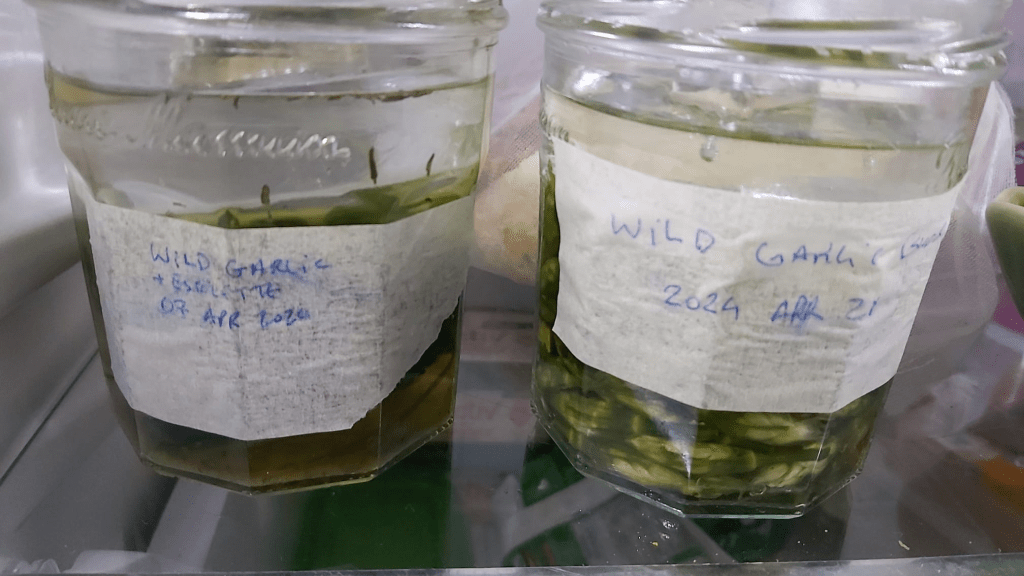
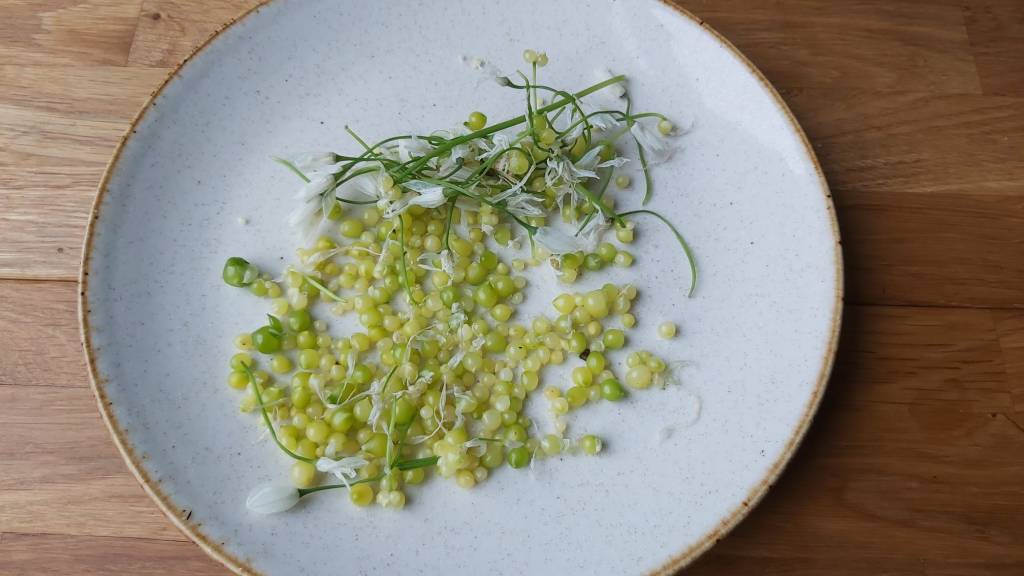
The wild garlic leaf was perhaps too brined to be eaten from the jar, but soups extremely well. The wild garlic flow buds are great as a garnish on cooked food. The wild leek…. “blibbles” I like to call them, were great tossed around a salad.
The flowers also carry a light oniony-garlicky flavour and decorate any dish fantastically. Truly, a wonderful wild plant, and passingly safe for beginners ! I saw passingly, because the leaves of both can be confused with other things when not being careful, so I would direct you to do your own research rather than rely on my meagre notes herepresent.
Buoyed by these successes, I started looking at some further fermentation projects. For the above items, I did consult several books, of which notes by Sandor Katz, American father of a recent revival of interest in the anglophone sphere, and a few safety tips just in case from people who looked to me on the surface of it who knew what they were on about, including Adam Ragusea, Josh Weissman, and Katz himself. I bought some pH strips to check our first ferments, but we’ve essentially established this rule for ourselves: if it looks, smells or tastes funky, then it’s out. Otherwise, it’s safe.
This is pretty much what Sandor Katz advocates, and Gata’s family has a long and living tradition of fermenting all sorts – so I know we’re in good hands. Just as well, because the pH strips tell me my ferments went from 6 up to 7, instead of going down to 4.5/below ! We’ve eaten the “ferments” now, and we’re fine, so I am confident. The only explanation we have of lack of acidification is that we used iodized salt, which we’ve been now told might inhibit fermentation. But the brining is definitely happening – so all should be good.
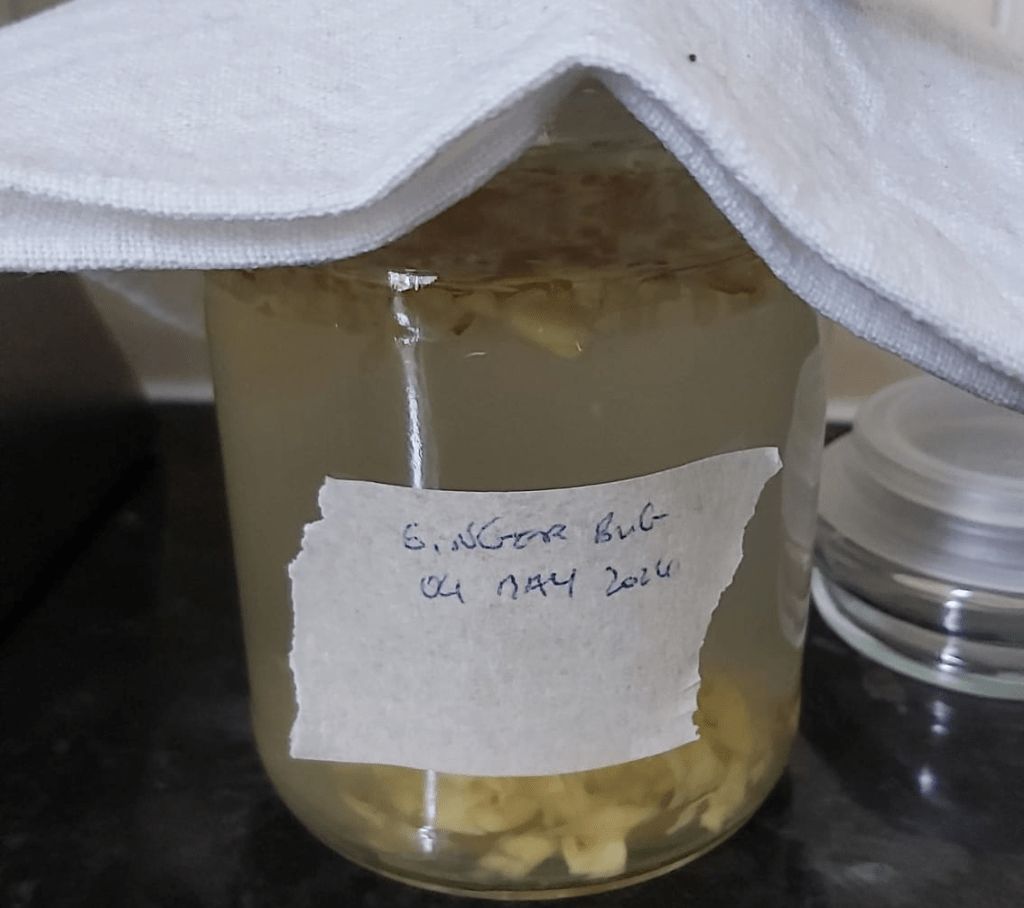
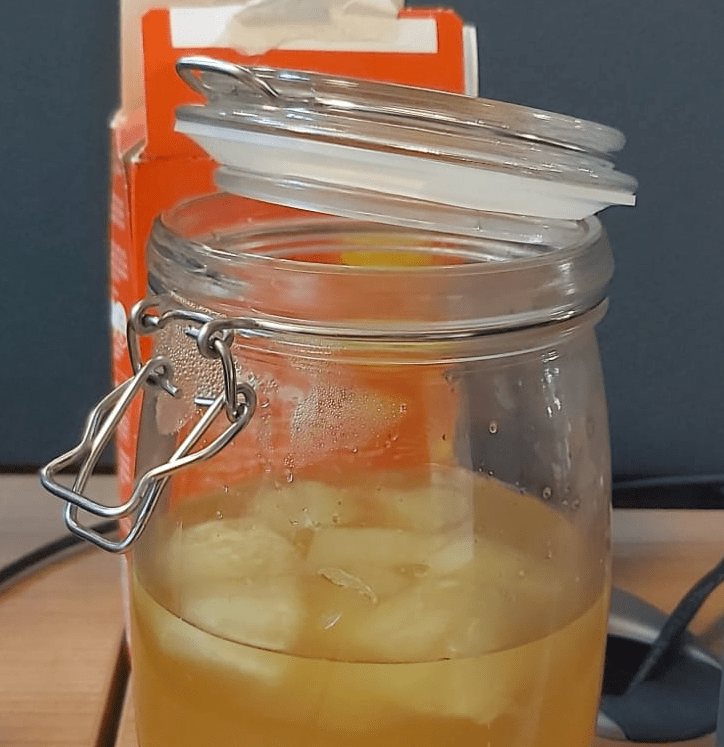
The other day I thus started a gingerbug, with the hopes of weaning myself off of commercial sodas in the long run. I have also been looking into a (modern?) twist on kvass , that of using just fruit, wild ferment, and sugar, without the traditional bread component, for a sweet red-berry bubbly juice. At work, I’ve started a jar of Finnish-style sima, which should yield a naturally carbonated lemonade by the end of the week, if not sooner, and again, steer away from commercial sodas.
Gata wants to have another go at kefir and yoghurt, as well as some cheese-making like her granny taught her (this is advanced stuff, I’m not sure I am ready to execute such recipes yet….)
And whilst brewing is a British national hobby these days, it requires quite a bit of kit, labour and precision ; whereas I am discovering through my personal research that “wine” is a much easier target – and doesn’t have to be limited to grapes. In fact, the initial starter is similar to the fruit kvass I mentioned previously, and further fermentation to higher alcohol content is optional. Similarly, starting out with honey and fermentation leads to mead, and with the right (yet still easy) steps and care, can lead to a pleasant beverage indeed.
So this year, I am preparing for more wild and fermented feasts, as hobbies to boot.
My reflection looking back on this brings a smile to my face every time I think of it:
Making things by your own hands brings satisfaction and peace;
In foraging and fermentation, it also brings a feast.
🍲
 Hero of Thyme
Leave a comment