
Get into any special-interest community and there is bound to be some sort of high-level low-key controversy that recent-initiates throw at even-newer beginners as a meagre flex.
One such in the fungi appreciation world is what does and does not constitute a mushroom, on a technical level – similar to what happens in the confusing world of fruit and veg.
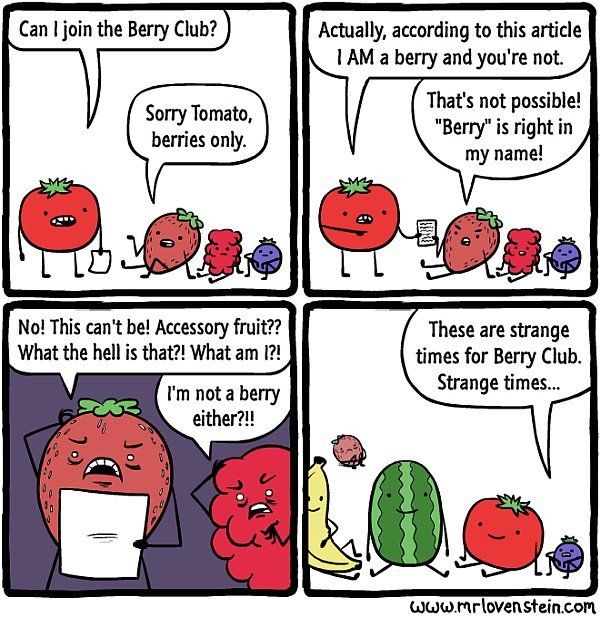
( Mr Lovenstein )
Now listen here …
To me it’s somewhat like the food argument “botanically, tomatoes are a fruit not a vegetable” (loud face-clapping ensues). The problem is one of semantics, vocabulary, or a bit more pointedly of semantic domain (to coin an expression, I’m sure there is a specific one for my use case, I have not gone looking, too busy typing). Contrasting “fruit” against “vegetable” is a culinary (cooking) distinction; whereas “fruit” has a clear botanical definition, but “vegetable” is so far out the field it’s over in a whole different biome altogether.
It should surprise none who know me that I can be rather much a pedant, but one of a particular variety: I can certainly abide by semantic fluidity in conversation and I do try to rein myself in (emphasis on “try”) – but I am fast-irked by fake pedants , and abhor false pedantry lobbed in my direction with a vengeance.
This is particularly felt when someone make generally positive and friendly noises like “jelly ears are a fun forageable mushroom!” and get met with “it’s not a mushroom, it’s a fungus.“

And don’t get me started on “toadstool.”
Actually, let me indeed start there. There is a folk assertion that “toadstool” referred to poisonous counterparts to edible “mushrooms,” but there is little if anything to be found upholding such a claim. At best we can only guess that it was a folkloric term for referring to “little growing things corpulent enough that small creatures could use as seating,” placing it in the semantic domain of storytelling folklore and not of foraging. Particularly, even in old texts, if it’s not referred to as a “toadstool” that DOES NOT imply any edibility!
Mousserons et champignons
As for “mushroom” itself, following the supposed etymology (which in folk settings is nearly always well-considered best-effort guessing), mushroom comes to us from mousseron, a French term that according to an article from l’Académie Française, and confirmed elsewhere, is used to specifically refer to a type of comestible macroscopic fungal basidiomycete, le mousseron de la Saint-Georges, a.k.a. the Saint George’s Mushroom, known colloquially as just mousseron or mousseron vrai (“true mousseron”). Contrast faux mousseron (“false mousseron”) used to designate specifically Marasmius oreades or in French marasme des Oréades, and known in English as…. the “fairy ring champignon” again borrowing the French word for “mushroom” in its generic sense. Thank you, Normans.
It can also be noted that “mousse” in mousseron via Latin is related to “mousse” as in “moss,” as some good mushrooms were in older literature and folklore associated with growing upon moss. Certainly when mushroom hunting, chances tend to be better at the base of trees where moss is found.
So what’s wrong with stating that the jelly ear (Auricularia auricula-judae) is “not a mushroom but a fungus?” In mycology, the study is of fungi in its sense of a kingdom of life, and all mushrooms are fungi – by definition, a “mushroom” is a type of fungus that has popped up a big spore-bearing structure of which we often like to investigate the comestibility. So, like the “fruit” argument, that much does hold – it is indeed a fungus. But what about the “mushroom” component?
Scientific nerdery …
In mycological terms, there are technical differentiations at many levels, but the ones that interest us here are Basidiomycota, Ascomycota, and Dikarya. Here’s a quick breakdown:
Of the kingdom Fungi, only the subkingdom Dikarya has members that produce “fruiting bodies” (I tire of writing longer-winded descriptions and have opted for the sloppy semantics of talking about “fruiting” *le sigh*). Dikarya is split into two phyla, Basidiomycota and Ascomycota. Roger Phillips refers to these as “spore droppers” and “spore shooters”, though more notably, basidiomycetes drop spores that form on basidiocarps, and ascomycetes disperse ascospores, or via other non-spore means: essentially being defined by being “not-basidiomyctes” and being the only alternative under Dikarya.
All the well-known mushrooms such as the cep (Boletus edulis) chanterelles (Cantharellus spp.), portobello/cremini/button mushrooms (all the same species Agaricus bisporus) etc are in Basidiomycota. The jelly ear is however in the Ascomycota phylum, along with the scarlet elf cup (Sarcoscypha austriaca). You could argue that the jelly ear and the scarlet elf cup not having stipes (stems) might be justified for shunting them off into “not a mushroom” territory. So a hopeful glance might try to squeak out that “mushrooms are the common name for basidiomycetes!”
However, consider:
- Chicken of the woods (Laetiporus sulphureus), hen of the woods (maitake, Grifola frondosa), and beefsteak fungus (Fistulina hepatica) are all Basidiomycetes . Are they mushrooms?
- Morels (Morchella spp.) and truffles (Tuber spp.) are Ascomycotetes . Aren’t they mushrooms?
You might be able to get away with challenging the mushroom-ness of chicken of the woods; but go ahead and pontificate to even a scientifically-unconcerned forager that their morels aren’t mushrooms and you’ll have a fight on your hands.
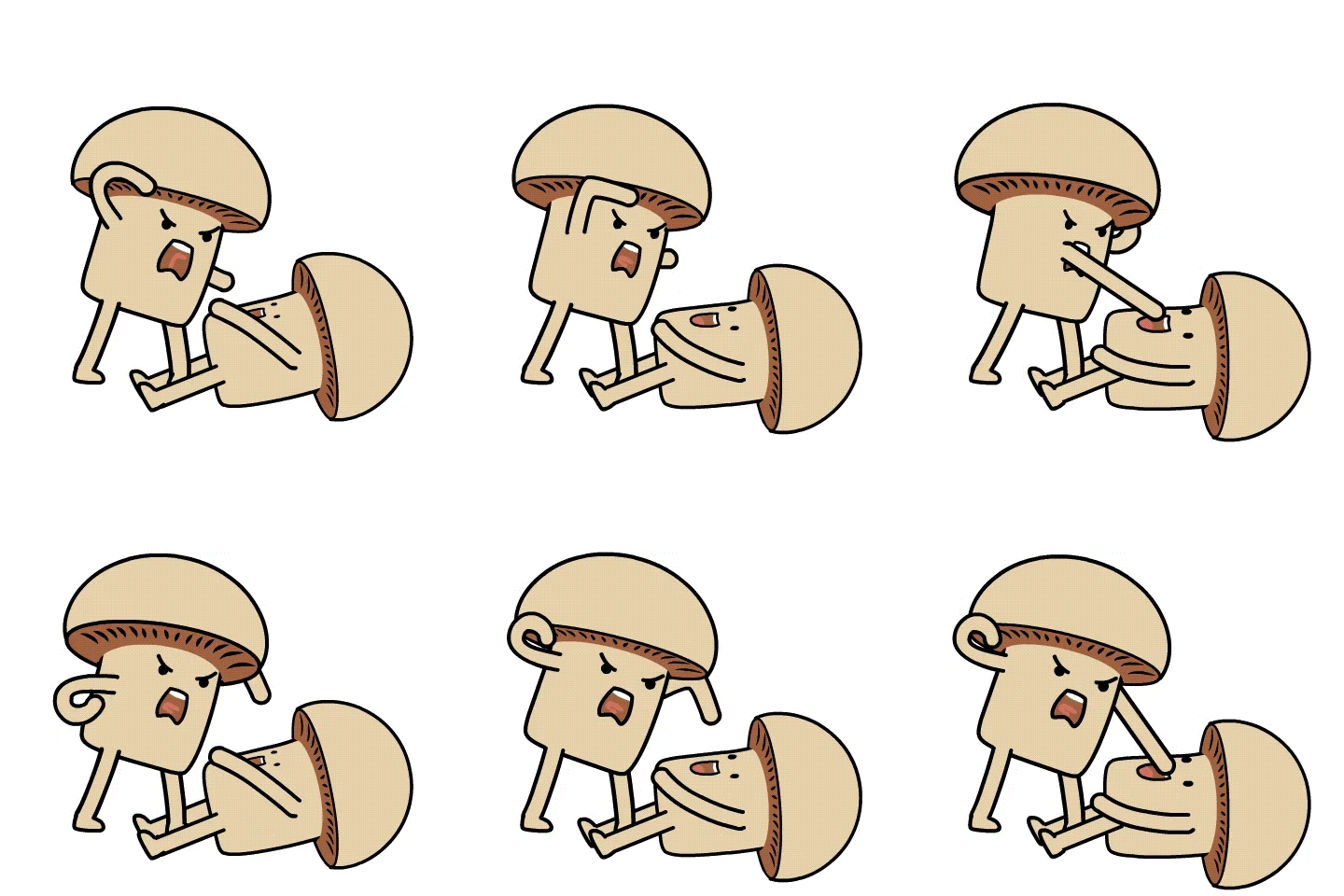
( from @mushroommovie )
Ok so how about we just open up to saying that Dikarya fungi are mushrooms and be done? Well….
- Yeasts (an informal name itself) are also Ascomycetes. Yes, yeasts are fungi. I accept that these are not mushrooms. I think we all do.
- Lichens are an association of an algae and a fungus (usually an ascomycete), and get their binomial name from their fungal component. Also acceptably not mushrooms.
Well, damn.
So what does count as a “mushroom”?
We come to the inevitable observation that “mushroom” is a folk term in common and current usage – and as a folk term, it grows and changes with the population that uses it. So long as no precision is required of the term and that a general “you know what I mean” vibe is enough, I am happy to semanticate that “mushroom” is anything that grows beyond the dimension of its stratum: if it is a fungus that pokes out from its growth surface, it’s a mushroom. Oh wait – truffles.
That is, the whole “it’s not a mushroom but a fungus” statement is as valid as making other such bold and insipid claims on popular culture vs specific domain.
Such as
- False Latin pedantry: “It’s virii not viruses!” 🤢
- False grammar pedantry: “It’s one datum, multiple data!” 🙄
- (“data” in English is uncountable, like “information,” fight me)
- False folklore: “Tinker Bell is a pixie, not a fairy.” 💥
🫢
 Hero of Thyme
Leave a comment