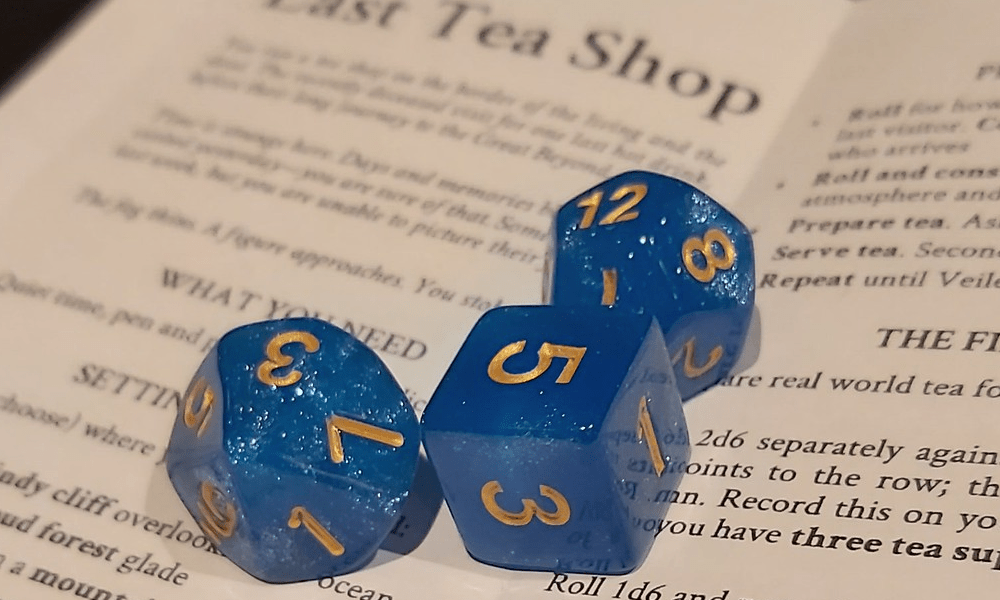
I started playing Magic: the Gathering during lockdown with my flatmate, and we discovered the joys of rich rulesets, fantasy theming, and endless variation of play. I got slightly suckered into buying several expansion boxes to give a good chance of building fun decks to play with, and spent a fair amount of time sorting through all the cards I had at my disposal (a paltry amount no doubt, compared to veterans of the franchise) to build a fully-featured deck of each colour. I think we pretty much managed to have at least one game every evening for over a year, before the real world came out of hiding and caught up with us again.
Sometime in the midst of this, we started musing how it could be cool to make our own cards, themed on our time at university – such plays as
- “Flat Party : Enchantment : red[2] ; When Flat Party is on the battlefield, all Student creatures get +1/+0”
- “Re-sit Your Exam ; Sorcery ; blue[2] ; return target creature to its owner’s hand”
- “The Popo ; Human Police Creature 2/2 ; white[1] ; When The Popo enters the battlefield, remove any ‘Party’ enchantments.”)
But then of course we pondered such cards as
- “Drunken Students ; Instant ; red[1] ; Target Player loses their next turn”
- “Swap Places ; Sorcery ; blue[3] ; Target Players swap seats and become the owners of their respective new hand, library and other owned playzones.”
This is some never-before seen wizardry to skip a turn in Magic and even more so the questionable seat-swapping; there are no rules to support implementing these, nor was there any real balance… And I was the keeper of the rules because I was invested enough in the backing mechanics to try to make it work. I had printed out whole sections, and occasionally had to pore over them to resolve doubts. The rules are well laid out, if extremely verbose – it reads like genuine legalese a lot of the time, which I felt I was used to at a lay-person level, what with having done my time researching software licensing and contract law back a few years.
This was hybris, and my downfall. I came to the rash conclusion that trying to start going down custom effects might warrant being free of the strictures of Magic rules altogether – and try to make my own.
I first went and got a bunch of card sleeves and blank cards to set about making something custom but when it came to trying to write some simple rules… I found out just how hard it is to
- make engaging content beyond one or two cards
- produce a good costing algorithm
- tie together many, many rule sections in clear and deterministic phrasing
- sort the bloody things into their sleeves, and swap them all out when you need to change everything …
I think I wrote and re-wrote so many variations on the idea of a card collector, mentally trying to play before committing to making anything tangible. The thought of writing content that would not work, and having to unmake a whole bunch of sleeved cards, felt daunting and I dithered a long time (arguably a trifling concern, but one that was sufficiently large in my mind to be an impediment… this was supposed to be something I was doing for fun).
In terms of the basic imperative motivations for the game, I had several areas of concern I wanted to address:
- I wanted to ensure that themability mattered
- I wanted to ensure costing would work
- I wanted to avoid play-throughs with resource paucity
Theming is important here – many games derive a part of their fun from being “the same game as X, but with characters from ThatFamousFranchise.” Wonder what happens when 🎲The Doctor goes up against 🎲Captain America, wielding 🎲a Holy Hand Grenade? Have at! The core idea driving this was the ability for anyone to add to the game whatever elements they felt would be fun. This comes with a complication: how to avoid game breaking items like “get three extra turns,” or at least make it very difficult to use or risky to add? Perhaps we could make it that any card must be drawn from a shared library of cards provided by each player?
The second point derived from the first – how do restrict powerful cards coming in too early, and create a reason to have both powerful and weak cards? After all if everything is free, it just becomes an arms race to see how hard you can punch.
The last point I had because I had a number of play-throughs where by the eighth turn I had still been sitting on two or three mana and unable to play, whilst tanking all the hits to the face. Luck of the draw, for sure, but not exactly “fun.”
I thought maybe sacrificing creatures from hand for their value could be a system – and introduce strategic decision-making – but then it felt like a bit of a waste and unsatisfying. If your hand contains a number of high value items, sacrificing one to play another feels not only frustratingly wasteful from a game experience point of view, but also allows for heavy imbalance in early game. Conversely Magic‘s land/mana system does prevent one side being able to spring-in big creatures too early.
The whole thing about themability being key also produced a conundrum – the intent was for anybody to be able to bring content to a play session, with the only limit being their imagination. What stops them from bringing a Sword of Winning hidden away? Well, perhaps we need to forcibly bind the content to rules like Magic does with keywords and numbers, so let’s write a bunch of rules, keywords, turn mechanics, steps and stages, etc for there to be more “things” to target with a rule. If there’s HP-gain and atk/def modifiers then we also want to make sure we’re forcing cards to have a predictable cost, so let’s put together a costing table, taking care of scaling and exceptions and…. oh this is growing arms and tentacles now, rein it in…! I did draw up several different costing systems and calculations, exceptions and asides, but every time I tried to apply them, they produced strange or nonsensical results. It was getting too much.
How Card Collectors are Ripe for Commercialization
It turns out that the Card Collector format only really works when there’s a central authority on the rules and the content – there’s no argument in the casual playing field about costing, no arguments about “that’s not our house rules,” and in the competitive clubs, there can be consensus and trust that any one player won’t have some unfathomably broken card… and when they do, it’s usually a card that gets revoked from “legal” play eventually, and everyone can know this.
When you open the doors to anybody bringing in anything, you don’t have any such guarantee. And designing costing rules to fit every situation, or even “most” situations, is a nigh impossible task.
Fortunately for the companies, this plays well into their business model (handy…). To keep up, you need to keep buying randomized content pouches, and this allows the introduction of “card scarcity.” One friend told me recently that he really could not fathom grown adults spending so much money on what is essentially a roulette with no value payout, for items of artificial scarcity. It boggles the mind.
So I started trying to think of other types of games that allowed players to exercise their creativity. Where card collector games define the content absolutely, at the other end of the spectrum lies… storytelling.
D&D – or “Let’s Pretend,” but for Grown-ups
At its heart, D&D is a sandbox for grown ups who don’t quite want to start writing full-on novels, but can’t allow themselves to just hang out with mates and “play at” being knights and necromancers.
If we’re gonna play, there have to be rules, and we gotta be serious about “immersion” and stuff. There needs to be a project manager I mean Dungeon Master to bring the team I mean the Party together, and give them achievable targets I mean a fun Campaign. It’s hilarious how much we cram rules into a game that’s meant to be about players inhabiting a world and using their creative thinking.
It may sound like I’m dumping on D&D and I’ve never even played it – but I took a look at character creation, classes, races, stats, abilities, expected growth and levelling, obtainable spells, campaign design notes, effect resolution steps and calculations, and all that and turned right around; so yeah, I am dumping on it. I really have no time for that.
Besides, I tend to prefer the idea of coming to a game with rules that could be understood and where the next course of action was from options rather than on-the-spur creativity. My girlfriend also stated a preference for rules over open-endedness, so invited her to play MtG with us a couple of times – but she decided there were “too many rules and too much stuff telling you what you can and cannot do, it’s exhausting.”
Upon hearing this, I was enlightened.
It’s like planning a multi-group holiday for the entire extended family, with assistance and dietary requirements, over three cities – and doing it for fun. Why can’t we just…. go have fun ?
Simple is Better
Our favorite post-dinner game is Uno. Or Bananagrams (we like words). Or Rummikub. I like a quick game of dominoes with house rules. I used to play yatzy (a simple dice rolling game similar to trademarked Yahtzee) with my dad and his friends during the summer vacations in the south of France.
The point is, games don’t need to be complex to be fun. You’ll know that some of the most enduring games have simple systems but allow for rich play – chess, checkers, so-called “Chinese” checkers, backgammon, mancala, othello, go… all fit this, and there are more.
Aside: in writing the above I was actually brought back memories I had long forgotten… I used to have a congklak (Malaysian mancala) tray when I was a child in Singapore, and the saga tree beads (seeds) I somehow had a small abundance of were my game counters. I’m just noting that to myself here… something-something foraging and making …
So why do we play such complicated games now as adults? What is the obsession with all these rules, and different counters for how many resources… It’s like modern game design needs to have a rich ruleset to support all the possible variability that an entire universe or franchise is going to rest upon.
A funny effect of this is seen in such franchises as Yugi-Oh and Pokémon: in their animated series, nearly every new opponent surprises the protagonists with extra rules, for extra special conditions, with extra bonuses, and go on to what is essentially a rulebook info dump. We gotta tell you these cool new rules.
I turned away from D&D and started looking for other systems… or maybe I just looked for “easy way to play D&D” and found that there are a plethora of other TTRPG systems out there… I found “FATE Core System” in that moment and spurred on by reviews, I bought the rules book which was super handy.
It’s billed as a rules-lite game system without all the math and restrictions on classes, aimed at embracing the creativity of the players without restriction by use of “aspects”: if you say your character “has super sniping abilities” then they do, no ifs or buts. It is tempered instead by the collective story-telling and compel system: it’s no fun after a while if the story is “and they won every encounter immediately.”
Each character also has a trouble, their personal difficulty, and a number of behavioural aspects summed up in phrases like “Can’t resist the shiny” or “Manners of a goat”, which can be used (“compelled“) as a reason why the adventure goes awry, and every time someone accepts their character being inconvenienced by a compel they get a Fate point.
Fate Points can be spent later to
- re-roll dice (once per turn)
- create plot points to their advantage (“can we say that X just happens?”)
- or just prevent nasty stuff from happening (hard “nope”).
It uses Fate/Fudge dice which give a modifier ranging from -4 to +4 to indicate degree of success of an action, which simplifies encounters and leaves out a lot of the math.
It does have a full collection of skill types to give some extra finesse to each character and define types of challenges that require more pointed levels of competence in particular areas, aspects notwithstanding, which adds a little more complication, and there are extra features for refreshing Fate points between sessions, taking significant damage by way of stress and consequences, and more to help manage the adventure over multiple sessions. We simply gotta have rules.
Some time later, I was intrigued by the review of another game: Magical Kitties Save the Day, which as it was being positioned as TTRPG-for-kids, I thought might have a nice system yet – and it does! It essentially goes off the same basic principle presented in Fate:
- The Kitty character has a name, a high concept (what they’re good at, as an aspect), and a trouble (what might complicate things).
- The player picks one super-power for their Kitty which can be one of the ones in the deck of suggested super powers, or just make one up – a bonus aspect.
- And get this: there are three stats “Fierce,” “Cunning,” and “Cute” for anything brawny, brainy, or charming, respectively. Set one at +1, at +2, and at +3, and … that’s it. That’s the skills done.
There’s an XP system and a little more which can thrown away, and campaign difficulty ratings which can be optional; and the rest is like Fate: fudge dice, rules lite, you can do what your aspects say you can do, and let’s tell the story together. It uses a system of “owies” and “injuries” that are your HP – you get two “hits “injuries” before being incapacitated for the rest of the scene, and if you accept a compel on your trouble you can get “kitty treats” (Fate points) to spend on preventing nasty things or re-rolling.
One review on Youtube calls out just how good the idea of not “forcing a story” onto players – just setting up locations, characters, and issues, and letting the players figure out the rest, in whatever direction they want. The GM section of Magical Kitties does a very good job of easing a new GM into the role if they’ve never assumed such before and I also found it much easier to wrap my head around the essentials of it than reading the excellent but verbose notes given in the Fate handbook. To make things more fun in TTRPG space and run simple campaigns, I may yet look at spinning off of Kitties‘ system for a simple “let’s play a 1h session at the pub” kind of approach…
What do I want to make?
Having sung the praises of Magical Kitties‘s take on Fate, why do I still want to make a new and distinct game? Kitties has all the theming, none of the costing, so what’s up?
Well I feel I still want to make a more approachable game for the more casual board game player – who just wants some set rules and play it like a rules game – but that still has space for the creative customization and theming that normally is only possible with TTRPG.
Imagine sitting down with some friends and going “let’s play a table top game” – and let’s say they’re open to it, but have never played one. (That’s kinda me actually. That’s exactly me.) They’re not sure what they’re getting themselves into and… well it’ll be a while to explain the rules to them, and it requires calling on their own creativity (which they may not have confidence in, or any practice in at all) and… even if you use the Kitties rules, it’s still not the easiest concept to sell to a bunch of friends for whom games on a table means card games or board games, but definitely we gotta have rules.
Roll and Venture!
This is what I’ve got by way of an elevator pitch description:
Grab the Gold! Fight the Foes! Work Together! Or Not!
Roll and Venture is a dice-and-paper adventure board game, ready to play in under 5 minutes, to bring the excitement of table top RPG to your non-TTRPG friends!
It provides a system and fundamental content, that allows players to bring their own content for infinite customisation!
What you need as material are:
- sheets of A4, plus pens/pencils
- a set of Fate dice
- a set of adventure dice (d4, d6, d8, d10, d12, d20)
- and your trusty little content booklet which you have on you for just this sort of occasion 😁
- Standard content, or fully custom, as you wish
It all packs away very compactly, don’t worry. To prep:
- Pick a class and a kin, and a single ability from the booklet, and you have a character.
- Give them an epic name. Or a silly name.
- Draw out a map grid, place some fun stuff like trees, walls, traps.
- Roll adventure dice pairs each to get coordinates to place enemies and treasure chests.
- Write the items that can be looted as treasure on pieces of paper, and put these in a hat or bag.
- (Maps are content too, and if you want to design a few in advance, that works just as well)
Now play! Move around, fight the foes, grab treasure (picking from the bag for randomness), defeat the boss, and see who’s got the most valuable amount of treasure! Do you work together all chummy? Or do you ensure that only you have valuables by the end of it?
The game session should be quick, everyone has a laugh. And then.
Someone thinks of a cool character to play next. Someone wants to add an awesome item/weapon to the bag. Someone thinks up a hilarious foe to battle. Write an entry for it somewhere.
Now play again – with the modified content! And yes, if someone suggests a “Sword of Winning” or “Bag of Infinite Money” then why not! And if you can tell it won’t be fun for your session that day, then just say, “another time.”
There are of course going to be some extra rules to refine because we need rules but one thing I did learn from Magic: the Gathering is that if you can name it, you can use it as the target of a mechanic. Try inventing interesting mechanics in a vacuum and you’ll fast be at a loss; but if there are set things to modify, like movement, resistance, strength, elemental interplay etc, even the shyest of can come up with specific actions that fit the theme.
What next
It’s taken me well over a year to reach this point. I wrote rules for a card system, then for an adventure system ; I tried to design it as a simple card-matching system that would double up as an adventure trading card game; I wrestled with costing, mitigating the possibility of game-breaking content, played with counter systems, I tried to invent different resource generation rules… it’s been a long journey. I have a folder full of notes and redesigns.
This new direction will still see some rulesets, but I intend to review and excise them ruthlessly to keep it as simple as possible, but still allow room for some targets and resources. If setup takes more than five minutes with brand new players, then the goal is not achieved.
Even the equipment is being kept minimal – the only specialist equipment should be the dice. I also want to encourage some much more ancient play practices: using seeds and nuts and pebbles and shells as game tokens. In imaginative play, the best collectibles are from your environment.
In short: simplicity rules.
🎲
 Hero of Thyme
Leave a comment