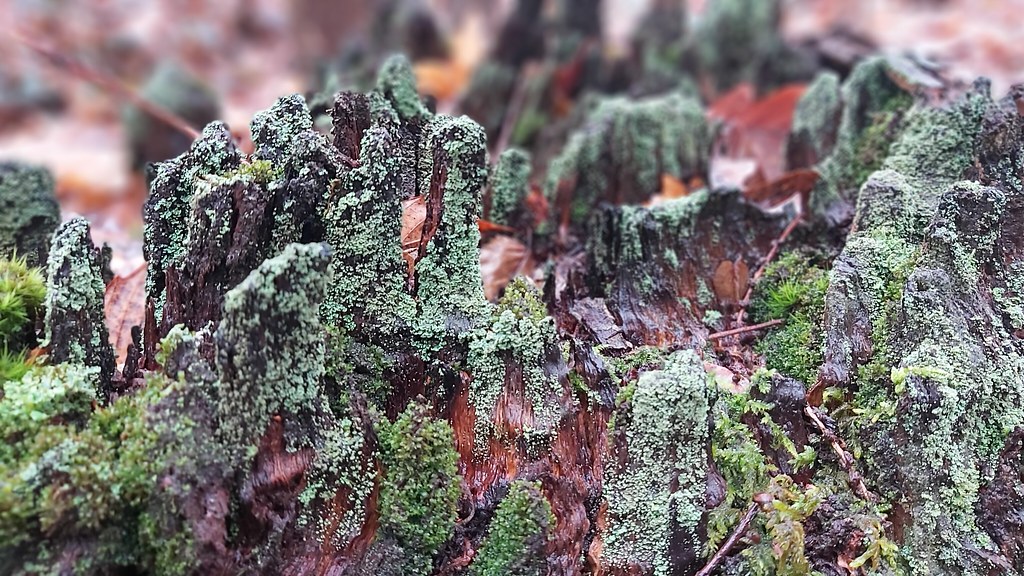
As my parents were settling down to watch Scotland face off against France in this year’s Six Nations, I decided to head out for a walk in the nearby Parc de Saint Cloud. It was a lightly rainy mood, but I was resolute – little for me to stay in for, as I have no particular interest in spectating any sporting event.
My deambulations took me past a cafe hut, closed, the outdoor flooring of which was simply old woodchip strewn on the earthy ground – typically a particularly hospitable environment for a certain popular family of fungi.
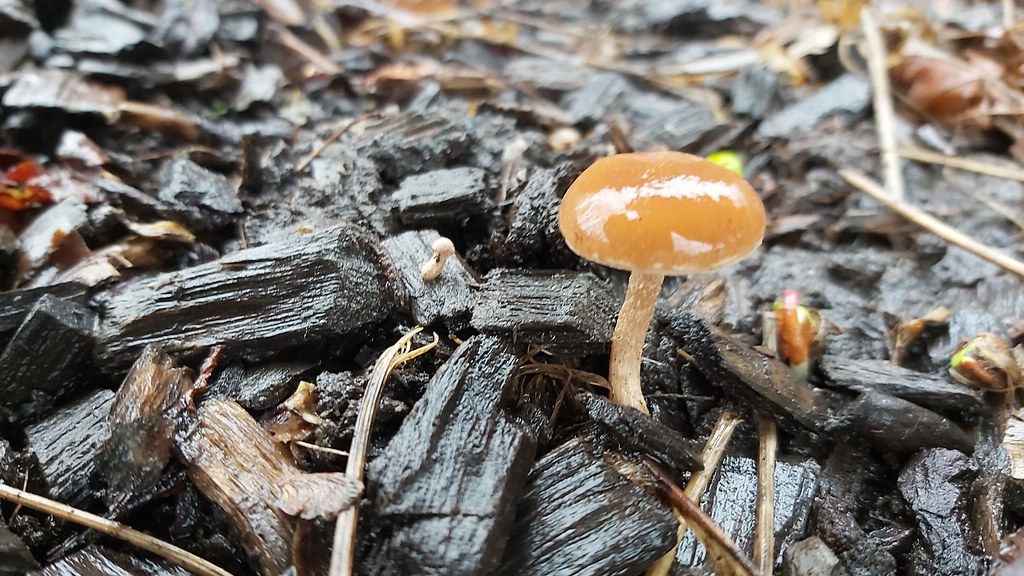
If you know you know, but the risk of it being a funeral bell (galerina marginata) is so great that it was best to just leave the wee blighters alone. There were quite a few…
(Edit January 2025 : I am now satisfied to identify this as some young Tubaria – inedible but harmless. “LBM” a.k. “little brown mushrooms” are a loose category vaguely implying “hard to identify, and usually not worth bothering, and certainly do not ingest”)
I did see a few others which I am as of yet unfamiliar with so I shall pass on commentary, but two I have managed with some basic sleuthing and environmental and seasonal deduction, to identify to personal satisfaction. Both assuredly are quite astounding to encounter up-close and personally.
The first I care to mention is a species whose appearance is mind-staggering:
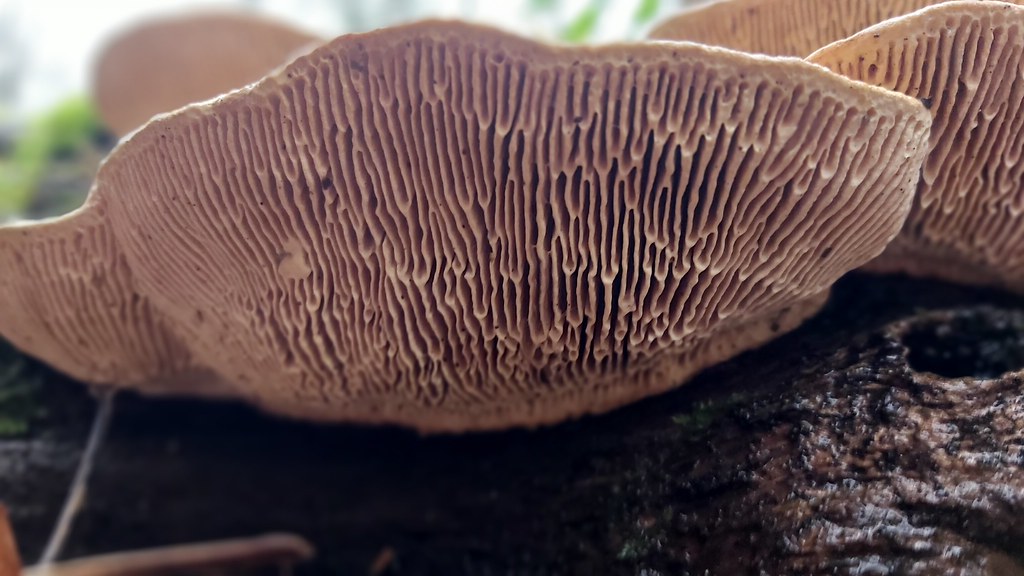
I am content enough to claim that this is an oak mazegill (Daedalea quercina), so named for its spore “pores” which rather than being small and tubular are instead very much large and elongated, such that in appearance they look like false, sturdy gills in the form of something reminiscent of coral, brain-like even, and most notably like a maze. (“quercina” simply means “of quercus”, thewhich is the scientific name for the oak family of trees)
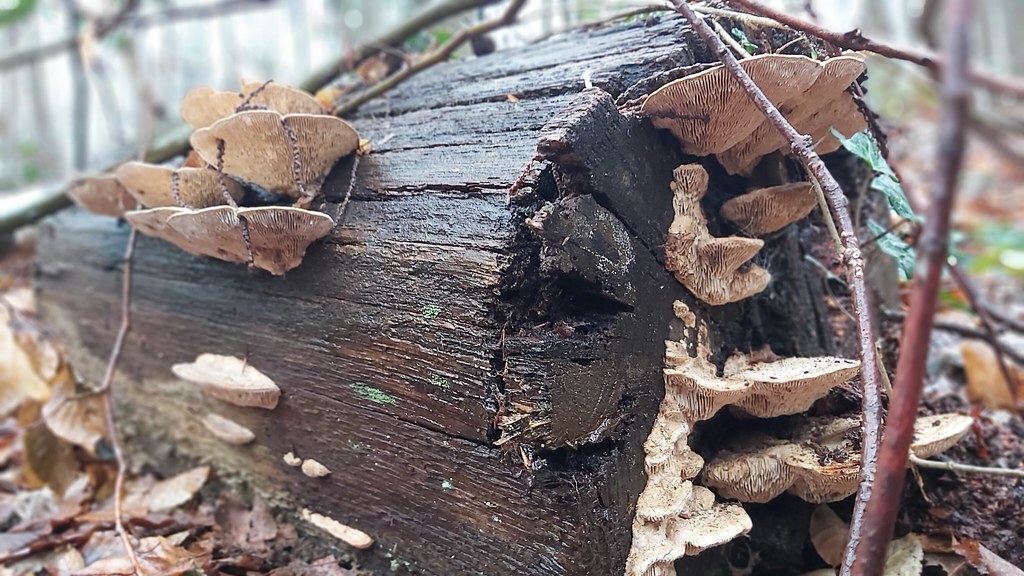
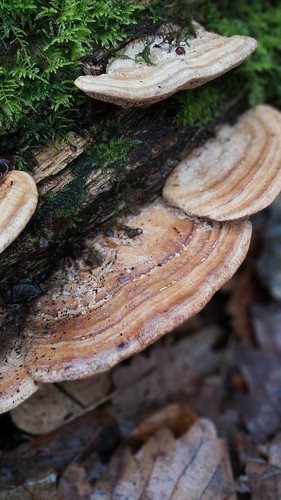
It grows in clusters on dead, deciduous hardwood, and I can say on that damp, comparatively warm winter day they were out in abundance. Of all the specimens I was snapping, I suspect these made the majority appearance.
The other I came across I nearly missed. Trundling up a muddy slope, I pondered the fact that perhaps not even two months ago would I have been caught dead walking in the woods in the rain (a strange state of being it would have been, to be sure 🧟♂️), but that day I was positively relishing it. Mushrooms around every corner! Remember to look at every hue of the ground, the leaf litter hides so much, and the skittish fungi hide so well… I turned around to confirm how much I had just clambered and… wow.
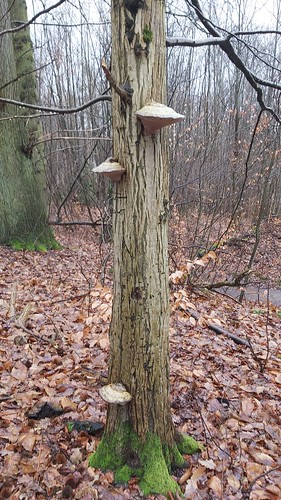
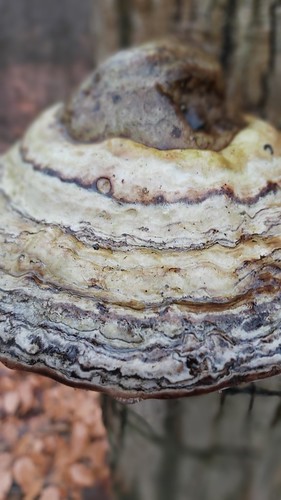
This old, presumably dying tree was sporting a bunch of big, beautiful polypores ! I had no idea what they were at the time, except that they were huge as far as my newfound exploration of fungi has ever shown me (with one exception). A couple of them had fallen some time before, now blackened from decomposition, but still hefty – I reckon they would have been weighed in kilos, rather than the customary grams of their smaller cappy kindred.
I am fairly sure these are hoof fungi (Fomes fomentaris) which apart from being impressive, and being decomposers of dead and dying deciduous trees, are notable for their use, after processing through potassium nitrate and drying, as the material “amadou”, as well as a fire starter, hence its other name, “tinder bracket.” They’re quite the exciting find for this casual observer.
I mentioned there being one bigger fungus I have encountered before – last year whilst walking through the woods near Dunkeld, we came across a whopper of a beast – a fully-grown dryad’s saddle (Cerioporus squamosus).
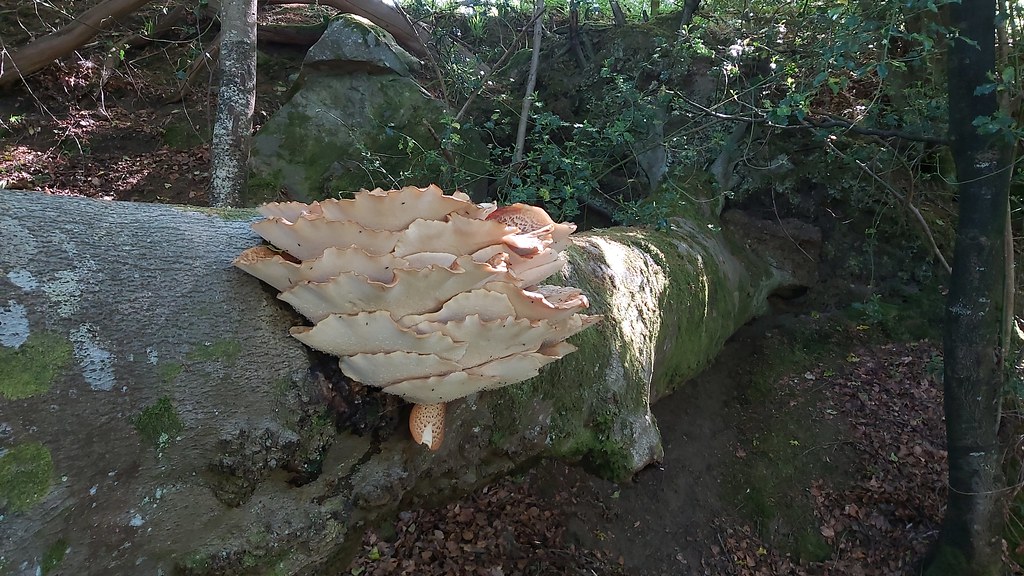
For scale, the whole specimen was as tall and twice as wide as my average-build upper body. The species particularly is edible, but only in its young growth state. This one was likely hard and maggotty at this point, and would serve only to awe passers-by. If I were to have explored, there is a passing chance I would have found some more.
I’ll look closer next time, but in the meantime, as we come out of our west-European winter, I am looking forward to more spotting. I have three identification field guides on order, and I plan to put them to immediate use. My favorite beginner species is the jelly ear (Auricularia auricula-judae), which not only is really nice in a soup or stew (you do need to boil them through for perhaps 5 minutes), but is also endlessly fun to wibble.
I have already learned that it is vital to use multiple, researched sources to perform identification. I want to eat some of my finds eventually, and I certainly do not want to be popping a Galerina.
Adventures await !
🍄
 Hero of Thyme
Leave a comment